The NEC requires terminations to be torqued to the manufacturer’s specified value using an approved means, which since the 2020 NEC is broader than a torque wrench.
For contractors, the practical job is to find the correct value, apply it consistently, and preserve enough documentation to show that the termination was completed properly. That process belongs in estimating, field procedures, quality control, and closeout, not just in an installer manual at the bottom of a gang box.
What 110.14(D) requires, and what changed
According to NEMA Technical Services Bulletin No. 120, the 2017 edition of NFPA 70, the NEC, added an explicit requirement in 110.14(D) to use a torque tool when the equipment manufacturer provides a numerical termination value.
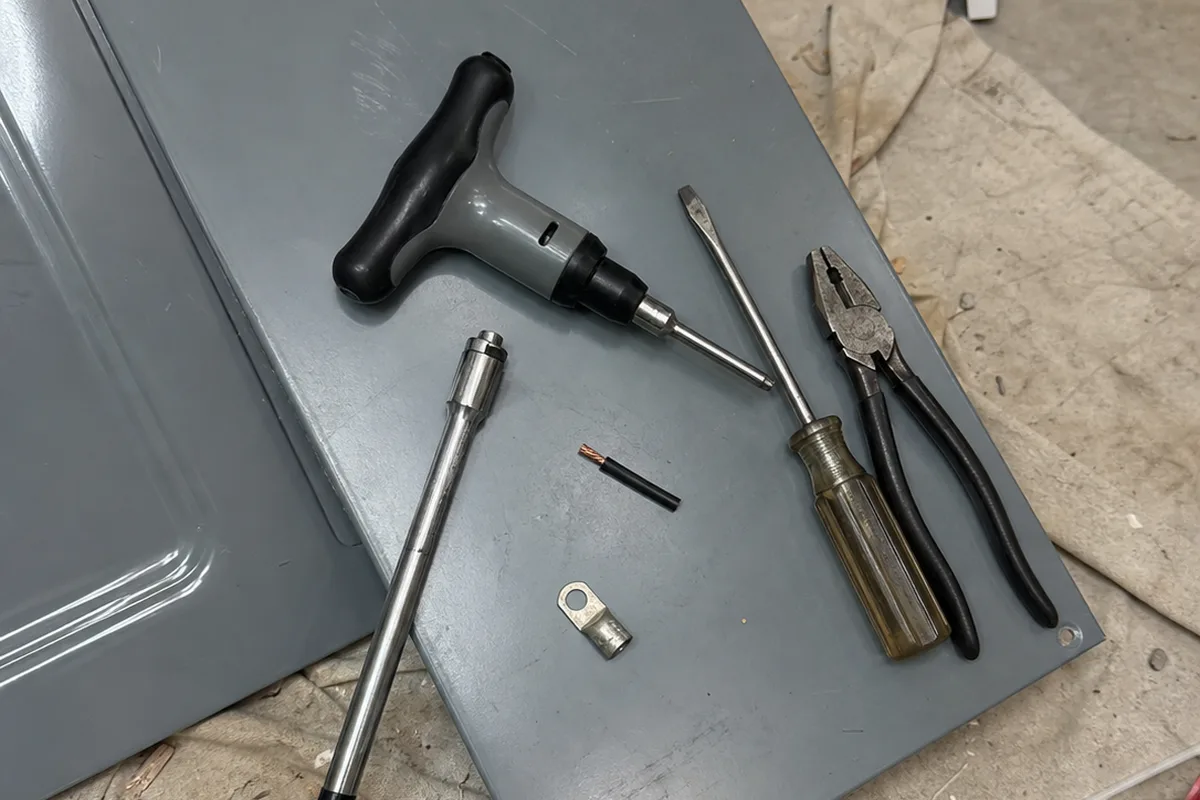
NEMA explains that the 2020 NEC modified 110.14(D), titled “Terminal Connection Torque,” to require proper torqueing by an approved means for terminations with manufacturer-specified torque values. Informational Note 1 gives examples that include torque tools, shear bolts, and breakaway-style devices with visual indicators.
That wording matters. A shop procedure that says every compliant termination requires a calibrated torque wrench states the 2020 rule too narrowly. A torque tool may be the approved means for a particular connection, but the NEC language also accommodates other approved devices.
NEMA characterizes the addition of 110.14(D) as a response to “the large number of termination failures and the demonstrated lack of use of torque tools in the industry.” NEMA is a manufacturers association offering technical guidance and recommendations. It is not an authority having jurisdiction. The AHJ enforces the code edition adopted in that jurisdiction.
That distinction is especially important when code changes are discussed in training or estimating meetings. Treat the edition named in a general article as historical context, then verify the edition and local requirements governing the actual project. The same discipline applies when reviewing topics such as arc-flash labeling requirements.
Why a loose termination costs more than a callback
A loose termination is not merely a punch-list problem. NEMA explains that improper torqueing can produce a loose connection whose resistance increases over time. The resulting temperature rise can degrade both the termination and protective insulation at that point.
NEMA also notes that aluminum and copper can develop oxidation where the conductor is exposed to air at the termination. At an improperly torqued connection, that oxidation may increase resistance and heat while reducing reliability.
According to NEMA, arcing at an improperly torqued termination can occur phase to phase, phase to neutral, or phase to ground. The associated high resistance and heat can degrade the termination and the reliability of the electrical system. NEMA further identifies voltage drop across a poor connection as a condition that can prevent equipment from operating effectively and significantly reduce its lifecycle.
For a contractor, the cost goes beyond sending someone back to the site. A bad connection can complicate troubleshooting, disrupt scheduling, consume supervision time, and weaken confidence in the rest of the installation. The right response is a repeatable process that makes correct torque part of production.
Account for that process when preparing labor and closeout expectations. Torque verification, value research, tool control, and records all take real project time. Include that time so the work does not get rushed. The same principle applies when deciding how to price electrical jobs without underbidding.
Where the torque value comes from
The manufacturer’s value comes first. NEMA explains that NEC 110.3(B), which first appeared in the 1975 NEC, requires installation in accordance with the manufacturer’s instructions. Manufacturer-specified torque values are part of those instructions and are to be used for terminations.
Build the search for that value into job preparation. Find it before the crew starts work so they have the correct approved means available. For service work, gather equipment information during intake when possible. A consistent set of questions can reduce surprises, particularly on panel upgrade calls before you book.
NEMA points to Annex I of the NEC when the equipment manufacturer does not provide a recommended torque value and that value cannot be obtained from the manufacturer. Annex I includes information for that limited situation and contains three torque tables taken from UL 486A-486B.
That is a fallback, not a substitute for available manufacturer instructions. If the manufacturer provides a value, that value governs. Crews should not reach for Annex I merely because its information is easier to find or already appears on a shop reference sheet.
A useful field record connects the value to the actual equipment and termination. Keep the process simple enough that installers will follow it, but specific enough that a supervisor or inspector can understand what was applied.
Do not re-torque, and what to do instead
NEMA does not recommend re-torqueing a termination after proper torque was initially applied during installation. Treating routine re-torqueing as preventive maintenance can therefore conflict with NEMA’s recommendation.
For maintenance after installation, NFPA 70B, the Recommended Practice for Electrical Equipment Maintenance, addresses threaded connections and terminations in section 8.11. NEMA reports that NFPA 70B recommends infrared scans and visual inspections as methods for detecting loose connections.
NEMA describes a limited technique when applying a torque tool is absolutely necessary. A torque tool set to 90% of the recommended torque value may be applied to detect a loose connection, and the circuit should be de-energized before the tool is applied. Keep those instructions together. The reduced setting does not remove the need to de-energize the circuit before using this technique.
The operational lesson is to separate installation verification from maintenance diagnosis. During installation, apply the proper value using the approved means. After installation, do not make routine re-torqueing the default inspection method. Follow the maintenance approach described by NFPA 70B and the equipment information applicable to the connection.
How inspectors actually check this
NEMA notes that inspection authorities may find overall compliance with NEC 110.3(B) and 110.14(D) difficult to determine. A completed termination does not necessarily reveal how its final condition was achieved.
According to NEMA, practices that inspection authorities may use include verifying torque tools and calibration certificates on site, observing random or periodic connections during the job, or obtaining an installer certification or affidavit stating that the specified values were properly applied. NEMA also notes that remote inspections using photos and videos are becoming common.
These are possible verification practices, not universal requirements imposed by every inspector. Ask the AHJ what documentation or observation it expects before the work reaches the inspection stage.
For the shop, that means the documentation method should be decided early. A project might call for a termination log, installer signoff, tool identification, photographs, or another record acceptable to the AHJ. Whatever method is selected, assign responsibility for completing and retaining it.
What this means for the shop
NEMA recommends torqueing all terminations performed on building wire conductor products in accordance with the NEC and the recommendations of the connector or electrical equipment manufacturer.
Put that recommendation into a workflow the crew can follow:
- Identify the manufacturer-specified value before making the termination.
- Confirm the approved means appropriate to that connection.
- Make the termination and record the verification required by the project or AHJ.
- Escalate missing values instead of substituting an assumed value.
- Use NEC Annex I only when the manufacturer does not provide a value and the value cannot be obtained from that manufacturer.
- Keep installation torqueing separate from later maintenance inspection.
Training should cover more than tool operation. Installers, foremen, estimators, and project managers need a shared understanding of where values come from, when Annex I applies, what records are expected, and why routine re-torqueing is not the default maintenance practice.
For California work, the California Department of General Services identifies the 2025 edition of Title 24 as current, with an effective date of January 1, 2026. That fact does not establish which NEC edition governs every project or answer how a particular AHJ will verify compliance.
Quick answers
What does NEC 110.14(D) require for termination torque? The 2020 NEC requires proper torqueing by an approved means when the manufacturer provides a specific torque value.
Does the NEC always require a calibrated torque wrench? No. NEMA explains that the 2020 NEC uses “an approved means,” with examples including torque tools, shear bolts, and breakaway-style devices with visual indicators.
Where should the crew get the torque value? Use the equipment or connector manufacturer’s specified value, as required through the manufacturer’s instructions under NEC 110.3(B).
Can a contractor use NEC Annex I when a value is missing? Yes, but only when the manufacturer does not provide a value and that value cannot be obtained from the manufacturer.
Which code requirement applies to the project? Confirm the requirement in the code edition the AHJ has adopted, since adopted editions vary by jurisdiction.